
A Third of My Employees Weren't People
A third of the people on my payroll weren't people. That company ran at 96% margins.
This was ten years before anyone was selling a workshop about it. I wasn't early to anything. I had very little cash and some very big milestones to hit. The only way a company our size could operate like a bigger one was to lean on technology for everything it could carry, so I used every piece of it I could get my hands on.
The structure I built
The structure itself was boring. Everything came in through one person. She knew the business and how I thought well enough to send it where it belonged. Under her, a few leaders each owned a whole area of the business, not a list of tasks. Under them, people and bots that did one thing and did it well. Most days I talked to my one person. That was the entire design.
If you've ever wondered why your week is full and your company still waits on you, that's the question the design answers.
The bots handled the things nobody should do twice. We needed to reconcile invoices with every insurer in the country. A person did it for about six months, then we built a bot named Andy to do it. Andy had his own email address, and the insurers wrote to Andy. "Thanks for staying on this, Andy." They had no idea Andy was a bot.
Andy was fun. Andy was not the point. What made the business work was that the work found its way to the right place without traveling through me first. The question I kept asking myself was: how do we design the org and the work so that I'm not the bottleneck? How do decisions move without waiting on me? What would it look like if only the things that truly needed my yes reached me?
You've probably asked yourself some version of those questions. Most founders ask them and then go back to answering email. This wasn't about doing less. It was about having the bandwidth to do my job.
The pitch that's wrong
A few weeks ago I sat in a workshop and watched someone diagram an AI workforce. Chief of staff at the top. Directors owning business lines underneath. Specialists under them, each with one job. It was my old org chart with different names on it.
And it's exciting. The structure I could only afford by being scrappy is now available to anyone with a subscription. You can have the chief of staff, the directors, the Andys, for roughly the cost of a software license. Every one of you reading this has access to it today.
Then came the pitch, the same one you'll hear almost everywhere right now: "Your new job is to manage your agents." Not only is that wrong, it's an expensive kind of wrong.
It tells you the hard part is learning a tool. Worse, it reinforces the thing most CEOs already believe, even if they'd never say it out loud: that they have to be everywhere and know everything. You're the manager, not the leader.
A leader isn't managing anything. A leader decides how work gets done and then stays out of it. That was true before any of us were born, and the tools didn't change it.
Design is your golden goose
The hard part is deciding who owns what, how work moves between them, and what reaches you. That's design. It takes thinking that goes beyond what needs to be done today or next week, and founders avoid it.
I'm building a house right now, and it's a decent picture of the difference. Nobody adds rooms because lumber got cheap. You decide what the house needs to be, an architect draws it, and only then does the contractor hire a crew. Put a bigger crew on a house with no plans and you don't get a house faster. You get a faster mess.
If you're a few years into your business, your org chart probably wasn't drawn. It happened. Someone was good at something, so they kept doing it. Something was on fire, so someone took it. Little by little you filled the roles you needed, mostly on the fly, and there was never a week to go back and ask whether it was the right design for where the business needs to go.
Now you have an AI workforce to add to that. Where most people are going to go wrong is believing that more people, or more agents, are what gets them to their goals faster. If everything routed through you with twelve humans, thirty agents doesn't fix that. It gives you thirty new places to be the bottleneck, and a better excuse, because now it sounds like a tooling problem. Bodies don't move the needle. Design does.
Designing an AI workforce is no different from designing your human team. It's the same work, done at the same time, because your people and your agents will be handing work to each other all day. The people who are going to be dangerous with this aren't the technical ones. They're the ones who design the foundation on purpose, because that's what makes the work move without them.
So let me show you mine, because I'm rebuilding it as I write this.
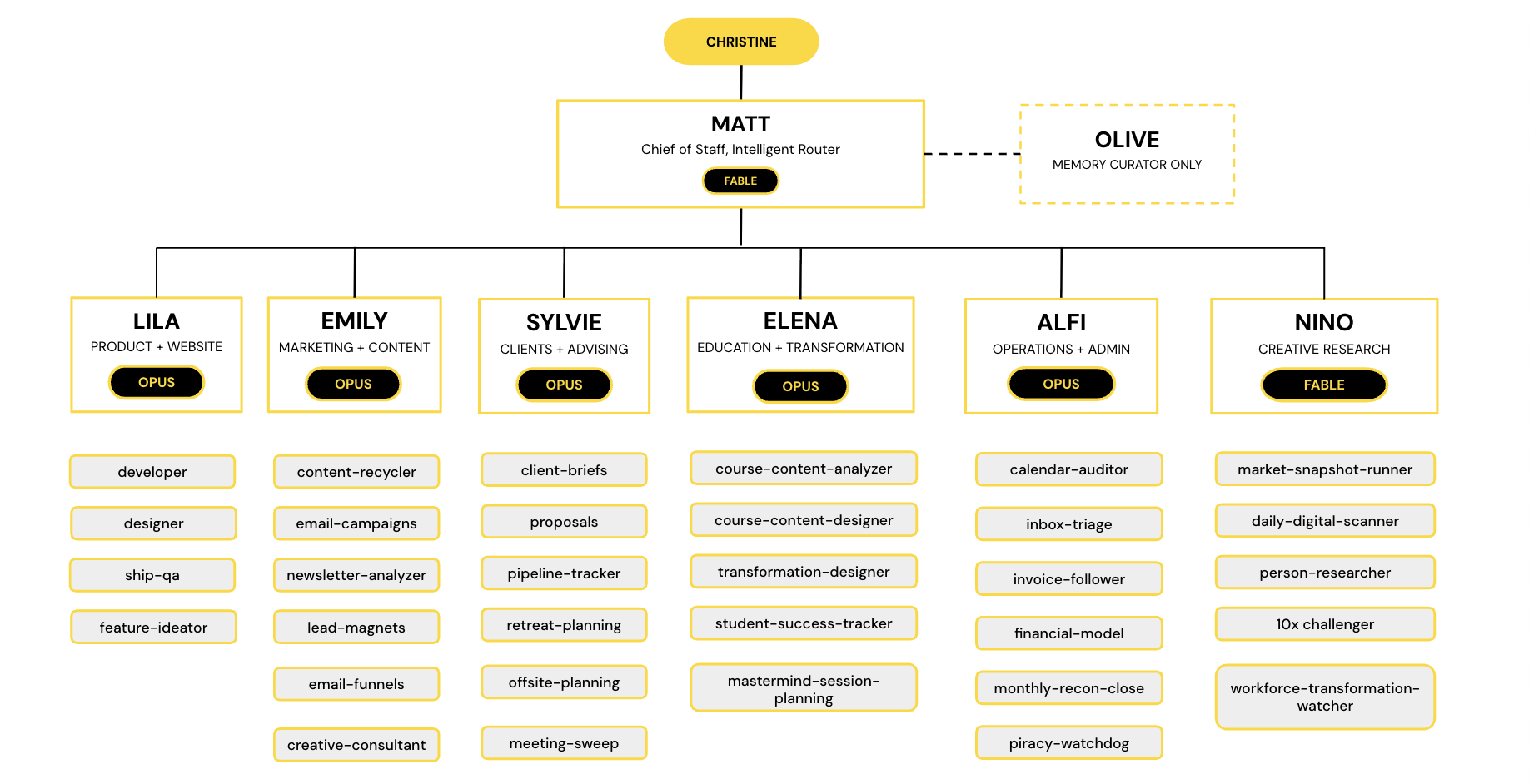
I talk to one agent. His name is Matt, and he's my chief of staff. He knows my goals, my calendar, my clients, how I make decisions, and what I'll never let an agent do. Under him are six directors. Each one owns a line of the business: marketing and content, the course, clients and advising, product and the website, operations and money. The sixth has one job: look at everything the others produce and ask how to make it ten times better. Under the directors are the specialists, each with one job, the way Andy had one job.
My human team works inside the same design. My editor and the person who runs my social hand work to the same directors and get it back. That's the part most people skip: the humans and the agents are one team, and the design has to hold both.
Anything that needs my judgment lands on one board, and I look at it once a day. Everything else runs without me.
It took weeks to get here, not an afternoon. It started from a one-page document about what the business needs to be by December, not from the tools. I've already redrawn the chart twice, and I'll redraw it again, because that's what design is.
It's hard. It's not impossible. It just takes time. That time is what puts every person and every agent on the work they're best at, instead of bolting them on because you needed a body.
Here's how I'd do it
Start from where the business has to be 18 months from now, and write down what has to be true for it to get there. Not tasks. Outcomes.
For each of those, name one owner, human or agent, and say what it owns. "Follows up with leads" is a task, and tasks come back to you. "Owns the pipeline from first call to signed contract, including deciding which leads we stop chasing" is an area. If you can only describe the role in verbs, you haven't designed anything yet.
Pick one door. One person, or one agent, that you talk to, who knows enough about how you decide to send work where it belongs. The moment you're briefing five agents individually, you've rebuilt the org where everything routes through the founder, except now it's faster at making you tired.
Decide what reaches you. Write down the handful of things that genuinely need your yes. Everything else is someone else's, and if it's still landing on your desk, the design is wrong, not the person.
Then add one role at a time. Only add it because the plan needs it, not because it's cheap. And when you find yourself correcting the same thing twice, stop correcting and go fix the design. That's the whole job. It's the job you had before AI, and it's still the job now.
A house with plans goes up fast. A business with a design runs without you. Neither one gets there by just adding bodies (or agents).
Reply or comment and tell me where work is sitting on your desk right now that shouldn't be. That's the first role I'd design. I read every one.
-Christine
If you want to go deeper
Here's where to start:
⚫️ Private Coaching: for early and growth-stage entrepreneurs who want to lead with more clarity while increasing their resiliency. See if we're a good fit here.
⚫️ The 20 Hour CEO Self-Paced Course: The frameworks, systems, and playbooks to stop being the bottleneck — on your schedule.
⚫️ The 20 Hour CEO Live Cohort: 3 weeks, 6 live sessions. Bring your actual business, rebuild how it runs, and leave with systems already in motion.